Trusted Rug Deodorizing Service Harlem NY: 2026 Guide for Queens Residents
A client from Jackson Heights called us last February with a problem she’d been living with for months. Her Moroccan wool rug had developed a persistent sour smell not overwhelming, but always there, particularly in the mornings when her apartment was closed up against the cold. She’d tried baking soda, a rented carpet machine, and two different enzyme sprays from the hardware store on Northern Boulevard. Nothing held. When she finally brought the rug to us, we could see within the first few minutes of inspection that the odor source wasn’t at the surface at all. That’s the situation we encounter regularly, and it’s exactly why a proper rug deodorizing service Harlem NY residents and Queens households both rely on looks nothing like a spray-and-vacuum approach.
Whether you’re in Astoria, Elmhurst, or Forest Hills, the seasonal patterns we track year after year tell us the same thing: the timing of when you address rug odor matters almost as much as how you address it. Waiting especially past certain points in the year turns a straightforward deodorizing job into a more complex, and more expensive, restoration.
Why Rug Odor in NYC Apartments Is a Diagnostic Problem, not a Product Problem
Before we talk about timing, it helps to understand why odor in a rug what is rarely it first appears to be. Dense urban housing, pre-war apartments with poor ventilation, and New York’s swings between humid summers and dry, closed-window winters create conditions that make rugs work like sponges. The odor you smell is almost always a symptom of something embedded in the foundation of the rug the warp, the weft, or the backing not something sitting on the pile.
Treating the surface without diagnosing the source is why so many DIY attempts fail. It also explains why some “quick dry” commercial services leave rugs smelling fine for a week and then reverting. The moisture they use reactivates whatever was already there.
The Six Most Common Odor Problems We See and What’s Actually Causing Them
1. Musty or Mildew Smell That Gets Worse in Summer
Symptoms: The smell is faint in winter, then becomes sharp and earthy by June or July. Often concentrated near the edges or the backing.
Likely cause: Moisture was introduced at some point a spill that wasn’t fully extracted, condensation from a window unit, or a rug placed on a slightly damp floor. In Queens apartments without central air, this is common. Mold or mildew colonizes the backing material and the knot base on hand-knotted rugs.
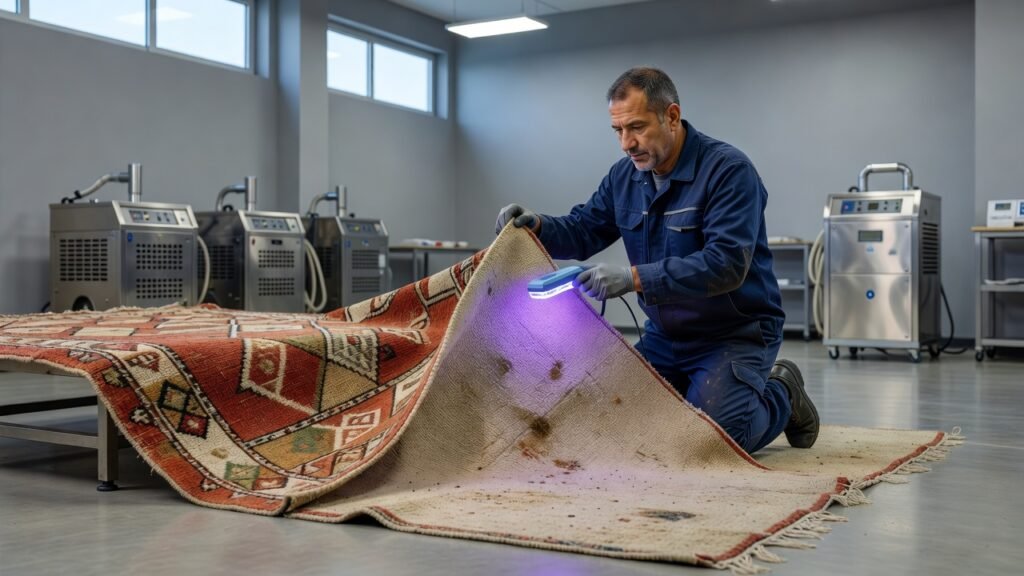
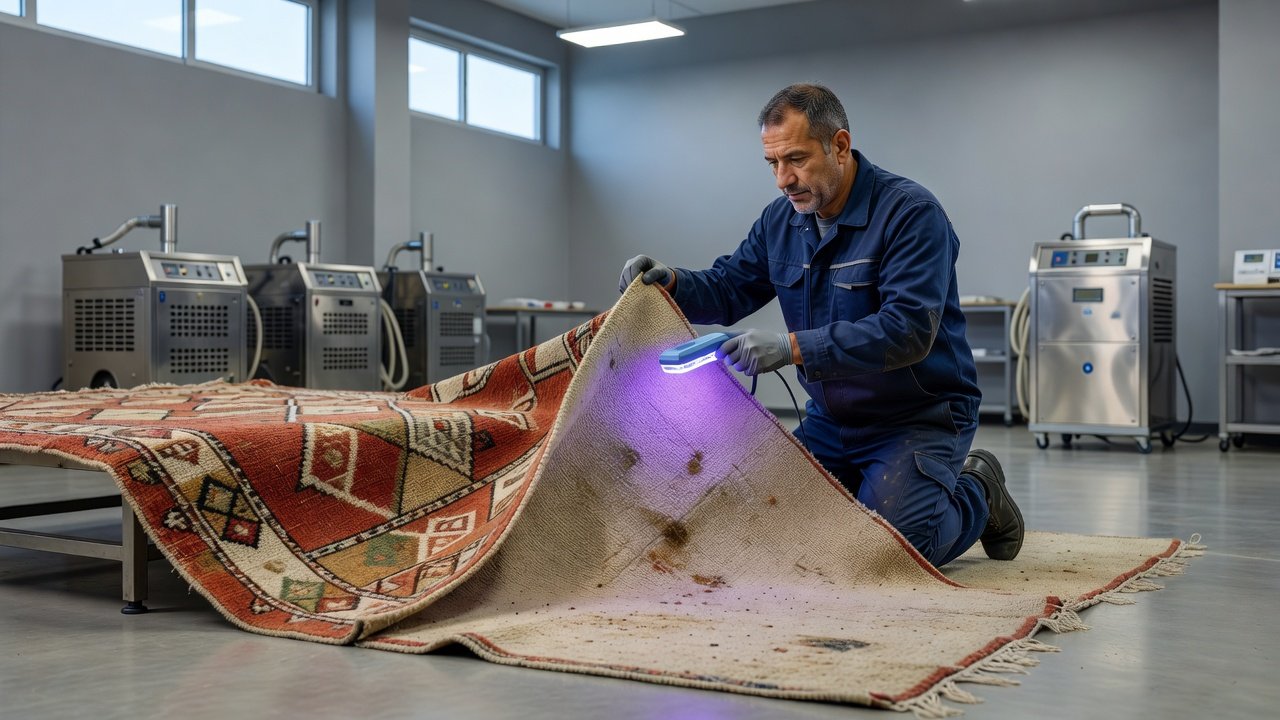
Professional fix: We inspect the backing under UV light, test moisture levels, and run a controlled dry-flush bath before any deodorizing agent is applied. The rug is then dried in a climate-controlled facility not air-dried in a New York City stairwell. According to the EPA, indoor air can be two to five times more polluted than outdoor air, and rugs trap significant amounts of particulate matter and biological material that accelerate this kind of odor problem.
Can this be prevented? Yes, rugs should be pulled up and inspected every spring before you close windows and run AC, not after the smell has already embedded itself.
2. Pet Urine Odor That Returns After Cleaning
Symptoms: The rug smells clean immediately after treatment, but the odor comes back within a few days, especially in warmer weather.
Likely cause: Urine salts are hygroscopic they absorb humidity from the air and reactivate. If the initial cleaning didn’t fully neutralize and extract the urine crystals from the foundation, they remain and revive. New York City has over 1.1 million registered dogs, and apartment dogs with restricted outdoor schedules make this one of our most common intake complaints.
Professional fix: We use a sub-surface flushing process, not a topical enzyme spray. The rug is immersed, flushed from both sides, and treated with a pH-appropriate neutralizer matched to the fiber type. Wool requires different chemistry than synthetic or cotton.
Can this be prevented? Address accidents immediately with cold water blotting and call us within 48 hours. Urine that sits longer than two days begins to penetrate the weft and warp at that point, surface treatment will never fully work.
3. Sour or Fermented Smell Following a Food or Drink Spill
Symptoms: A localized, slightly sweet-sour odor that’s stronger when the room is warm.
Likely cause: Organic material wine, juice, coffee was absorbed into the pile and foundation. Bacteria feeding on the sugars in the spill produce volatile compounds that smell fermented. This is accelerated in kitchens or dining areas of smaller apartments, common in Flushing and Woodside where open-plan living is the norm.
Professional fix: The affected zone is tested for pH and bacterial load. We use a controlled enzyme treatment calibrated to the specific organic compound, followed by a hot-water extraction pass and a controlled dry. The IICRC recommends professional rug cleaning every 12 to 18 months for most households precisely because organic contamination accumulates invisibly between visible staining events.
Can this be prevented? Blot spills immediately never scrub and do not apply commercial stain removers that contain optical brighteners or bleach derivatives. These disrupt the fiber’s surface chemistry and make future professional treatment harder.
4. General Flat Odor After Years of Low-Traffic Storage
Symptoms: A rug pulled from storage or inherited smells stale, slightly dusty, and closed off not sharp, just dull and unpleasant.
Likely cause: Off gassing from accumulated particulate matter, oxidized fiber oils in wool, and residual chemical breakdown in synthetic backings. Not dangerous, but not something that airs out on its own.
Professional fix: A full immersion wash, gentle agitation, and a deodorizing rinse with pH-balanced agents. We also comb and groom the pile before drying, which helps open the fiber structure and release trapped compounds.
Can this be prevented? Store rugs clean, wrapped in breathable cotton not plastic and in a dry space above ground level.
5. Chemical Smell from a Previous Cleaning
Symptoms: After a cleaning elsewhere, the rug has a sharp chemical or perfume odor that doesn’t fade.
Likely cause: Over-application of synthetic deodorizing agents, or a cleaning solution that wasn’t fully rinsed. Some lower-cost services mask odor with fragrance compounds rather than neutralizing the source.
Professional fix: We do a dilution flush to remove residual chemistry before re-treating. A 2022 report from the Rug and Textile Appreciation Society notes that improper DIY or under-equipped professional cleaning is one of the leading causes of irreversible fiber damage and chemical residue left in the foundation accelerates that breakdown over time.
Can this be prevented? Ask any service provider what rinsing process they use. If they can’t explain it, that’s your answer.
The Rug Deodorizing Service Harlem NY Timing Window That Most Queens Residents Miss
The best time to book a rug deodorizing service is March through early May, before New York’s humidity climbs above 60 percent for sustained periods. Once summer settles in, odor-causing bacteria and mold spores reproduce faster, urine salts reactivate more aggressively, and drying times at our facility while still controlled require more attention to temperature management.
The cost of waiting isn’t abstract. A deodorizing treatment on a rug that comes to us in April typically stays in the one-service category. The same rug, same problem, arriving in August after three more months of New York summer humidity frequently requires a second pass or, in the case of mold, a fiber-level sanitizing treatment that adds to the total. We’re not suggesting urgency for its own sake we’re telling you what we actually observe across dozens of rugs every week.
Fall is our second-best window, specifically September and October. Rugs cleaned before you close your windows for winter arrive at the cold season fresh, not carrying six months of accumulated moisture and bacterial activity into a sealed apartment.
If your rug has an odor issue you haven’t been able to resolve, reach out to us at upperrugcleaning.com. We serve Queens, Harlem, and the surrounding boroughs with free pickup and delivery, and we’ll give you an honest assessment of what’s causing the problem before we quote you anything.
Frequently Asked Questions
How is a professional rug deodorizing service different from using a store-bought enzyme spray?
Store-bought sprays work on the surface of the pile. Professional deodorizing involves identifying the odor source which is often in the foundation or backing of the rug and flushing or neutralizing the material at that depth. Surface treatment on a deep odor source will temporarily mask the smell but won’t resolve it, particularly in warm or humid conditions common to New York apartments in summer.
How long does rug deodorizing take, and will my rug be returned the same day?
Most rugs we receive for deodorizing are returned within three to five business days. Proper cleaning and deodorizing require thorough extraction and controlled drying rushing that process with forced heat or minimal drying time is a primary cause of shrinkage, dye bleed, and mold recurrence. We do not offer same-day turnaround because it compromises the result.
Can you deodorize a rug in my apartment, or does it need to come to your facility?
For anything beyond a very minor, isolated surface odor, the rug needs to come to our facility. Effective deodorizing requires full immersion washing, sub-surface flushing, and climate-controlled drying — none of which can be done properly in a Queens or Harlem apartment, regardless of the equipment brought on-site. In-home treatment that uses wet methods in an enclosed space also risks introducing moisture to the floor underneath, which can cause its own problems.
Related from Upper Rug Cleaning: How Upper Rug Cleaning Earns and Verifies Customer Reviews in Manhatta · Professional Rug Cleaning Services in Manhattan, NY · Moroccan Rug Cleaning NYC