Essential Persian Rug Cleaning Upper East Side New York: 2026 Guide for Harlem Residents
Most people assume any rug cleaner can handle a Persian. That assumption has cost some of our clients hundreds sometimes thousands of dollars in preventable damage. Persian rug cleaning Upper East Side New York is a specific, skilled service, and knowing how to choose the right company before you hand over an irreplaceable piece is exactly what this guide is about. Whether your rug has been in the family for decades or you picked it up at a gallery on Fifth Avenue, the stakes are real.
Last fall, a client from Hamilton Heights brought us a late-19th-century Tabriz that a previous cleaner had over-wetted. The foundation was distorted, the fringe had felted, and the dyes in the border had migrated into the field. She had paid $120 for what she thought was a bargain clean. Restoration cost her significantly more than a proper cleaning would have. We hear versions of this story constantly from customers traveling down from Harlem and Washington Heights to our facility and it almost always starts with skipping the vetting process.
Why Timing Matters More Than Most Rug Owners Realize
There is a genuine cost to waiting, and it is not just abstract wear. Harlem apartments many of them pre-war buildings with radiator heat and uneven humidity create real seasonal stress on wool and silk rugs. Winters dry the fibers, summers bring the humidity back up, and the freeze-thaw cycle outside tracks in road salt and particulate grit that works its way deep into the pile. The longer that material sits, the more abrasive damage it does to the knots.
Spring, roughly March through May, is widely considered the best window to book a professional cleaning. The rug dries more predictably in moderate temperatures, and you are ahead of the summer humidity spike that can slow drying in a facility and create conditions for mildew. Fall, September through October, is the second-best window get the rug cleaned before the radiators come on and bake in whatever accumulated through summer. According to the EPA, indoor air can be two to five times more polluted than outdoor air, and rugs trap significant amounts of dust, allergens, and particulate matter, a particular concern in dense urban environments like New York City.
Booking in January or August the two periods most Harlem residents tend to delay to also means competing with the companies that operate on volume and speed rather than care. The reputable specialists fill up fast in spring and fall. If you wait until late June, you may end up with whoever has availability, not whoever has the credentials.
Credentials That Actually Mean Something
The rug cleaning industry has no universal licensing requirement in New York State, which means anyone with a van and a pressure washer can advertise Persian rug cleaning Upper East Side New York. That is precisely why third-party credentials matter.
- IICRC certification — the Institute of Inspection, Cleaning and Restoration Certification sets the most widely recognized technical standards. Look for technicians certified under the S300 Textile Cleaning Standard specifically.
- Association of Rug Care Specialists (ARCS) membership — smaller than IICRC but focused exclusively on rug care, not general restoration.
- In-plant facility, not on-location steam cleaning — legitimate Persian rug care requires a dedicated wash floor, proper drying systems, and controlled conditions. A company that only does on-site work is not equipped for hand-knotted textiles.
- Evidence of dye-testing and fiber identification in their intake process — any reputable cleaner should ask what the rug is made of and test for dye stability before applying any wash solution.
The IICRC recommends professional rug cleaning every 12 to 18 months for most households, and more frequently in high-traffic or pet-owning homes. In a Harlem brownstone with a dog and street-facing windows, annual cleaning is not excessive — it is appropriate maintenance.
Questions to Ask Before You Book
A good cleaner will welcome these questions. A bad one will dodge or oversimplify them.
- Do you clean rugs in-plant, or do you clean on-site? Where is your facility located?
- How do you identify fiber content and test for dye stability before washing?
- What is your drying process, and how long does it typically take for a hand-knotted wool rug?
- Are your technicians IICRC-certified or trained under a comparable standard?
- Do you offer a written condition report before and after cleaning?
- What is your policy if damage occurs during the cleaning process?
- Can you provide references from customers who brought in similar pieces — Persian, Turkish, or other hand-knotted rugs?
If a company cannot answer questions three and four clearly, move on. Vague answers about “our process” without specifics about drying temperature, wash chemistry, or fiber assessment are a warning sign.
Red Flags That Signal a Bad Operator
We have heard enough intake conversations to recognize the patterns quickly. Watch for these:
- Pricing quoted per square foot over the phone without seeing the rug — legitimate quotes require a visual assessment, at minimum a photograph.
- No pickup and delivery option for a city where most Harlem residents do not own cars. Rolling a large Kashan down the subway stairs is not a reasonable alternative to white-glove transport.
- Guarantees of same-day or next-day service on hand-knotted pieces. Proper washing and drying of a quality Persian takes two to five days minimum.
- No mention of fringe treatment or pile direction in their intake process — these are basic concerns any trained technician raises.
- Reviews that focus only on wall-to-wall carpet cleaning, with no mention of area rugs or hand-knotted textiles specifically.
Improper DIY rug cleaning — including over-wetting, harsh detergents, or machine washing — is one of the leading causes of irreversible damage to wool, silk, and hand-knotted rugs, according to the Rug and Textile Appreciation Society. The same principle applies to underskilled professional operators working without appropriate equipment.
How to Compare Quotes Without Getting Misled
Price ranges for Persian rug cleaning in the New York metro area in 2026 run roughly $4 to $10 per square foot for standard hand-knotted wool, with silk or antique pieces commanding more. A 9×12 rug at the low end of reputable pricing is around $430 to $550. If a quote comes in at $150 for the same piece, that is not a deal it is a signal that something in the process is being skipped.
Ask each company what is included: pickup, delivery, fringe cleaning, pre-treatment, drying, and any protective finishing. Some operators quote a base price and add fees for each of those services individually. Others include them. You are comparing total cost and total process, not a single number.
Also ask about turnaround time explicitly. A company that turns around a Persian in 24 hours is either cutting the drying phase short or not doing a full wash. Neither is acceptable for a rug worth protecting.
Bringing Your Rug to the Right Hands
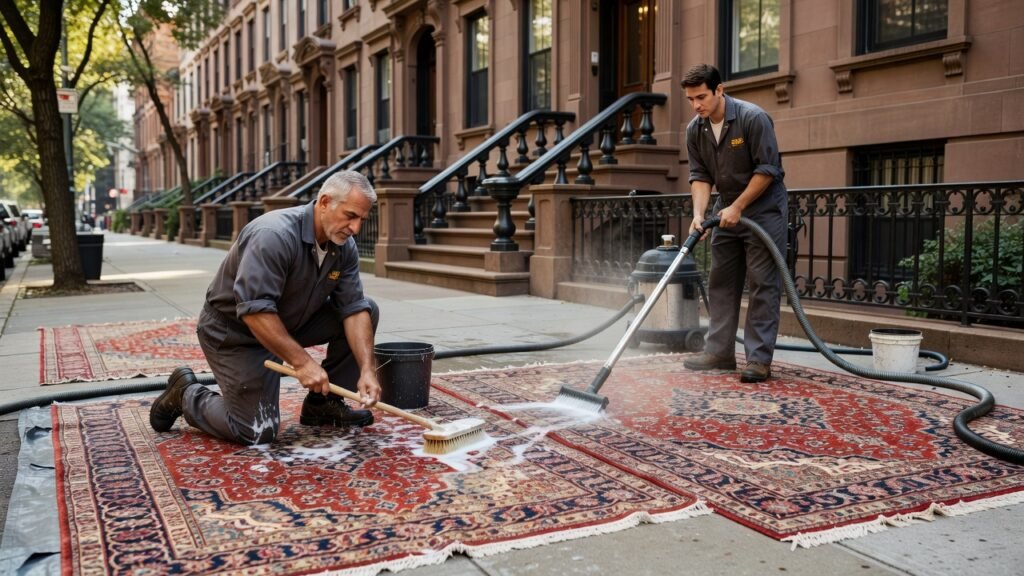
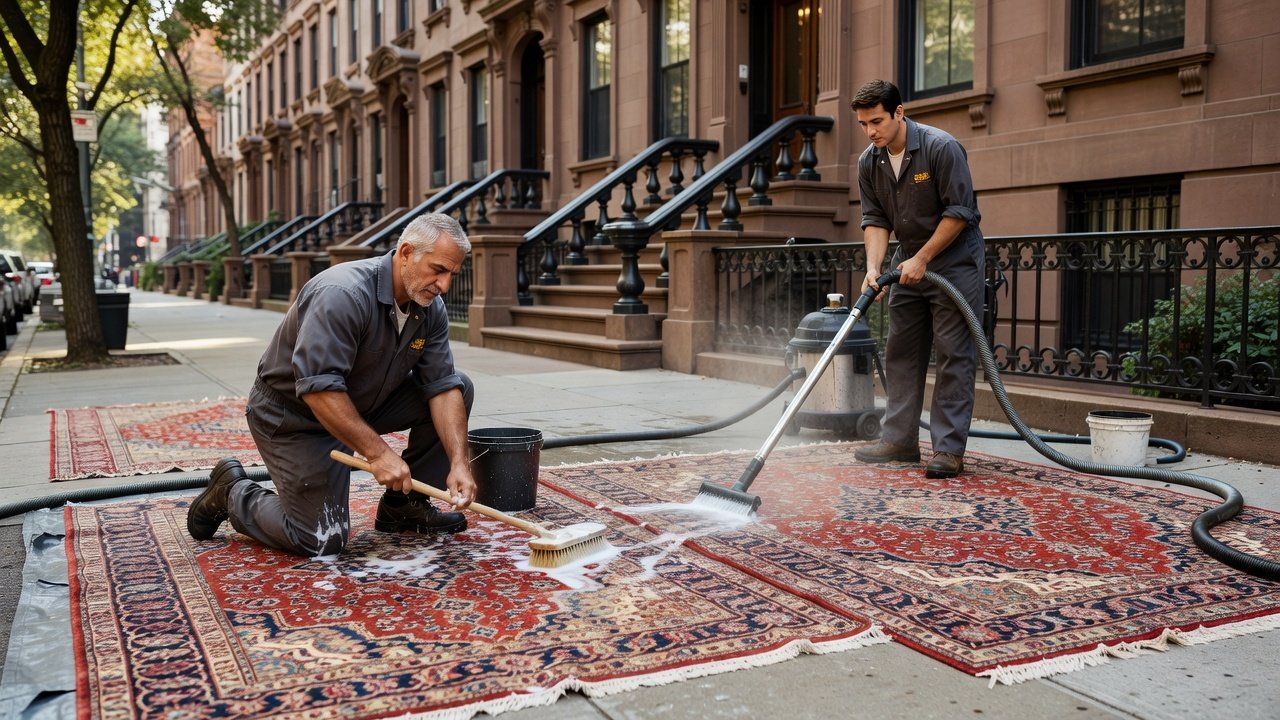
If you are in Harlem, Morningside Heights, or anywhere along the 2 or 3 train corridor, getting a large rug to a proper cleaning facility is a real logistical question. We offer white-glove pickup and delivery across Manhattan, including throughout Harlem, and our wash facility handles Persian, Turkish, Moroccan, and Central Asian hand-knotted rugs every week. We document the rug’s condition before and after, so you know exactly what we found and what we did.
Visit upperrugcleaning.com to schedule a pickup or ask us a question about your specific piece. The best time to book is before your rug needs it urgently once damage sets in, cleaning becomes the smaller part of the conversation.
Frequently Asked Questions
How far in advance should Harlem residents book Persian rug cleaning before spring?
We recommend booking four to six weeks ahead of when you want the rug back in your apartment. Spring slots at reputable in-plant facilities in the New York area particularly those serving Manhattan clients traveling from Harlem or the Upper East Side fill up in February and early March. If you wait until April, you may face longer turnaround times or limited availability at the cleaners who actually specialize in hand-knotted textiles.
Is Persian rug cleaning different from standard area rug cleaning, and does it cost more?
Yes, on both counts. Hand-knotted Persian rugs require fiber identification, dye stability testing, pH-controlled wash solutions, and controlled drying to prevent foundation distortion none of which apply to machine-made synthetics. The cleaning process is slower and more labor-intensive, which is why pricing is higher. A proper cleaning protects the structural integrity of the rug, not just its surface appearance.
What should I do between professional cleanings to maintain a Persian rug in a New York City apartment?
Rotate the rug every six to twelve months so foot traffic and UV exposure from windows wear evenly across the pile. Vacuum with a suction-only attachment no beater bar in the direction of the pile, not against it. If you live in a pre-war building with radiator heat, consider a humidifier in winter to prevent the wool fibers from becoming brittle. Address spills immediately by blotting, never rubbing, and avoid any store-bought spot remover unless you know it is pH-neutral and safe for natural dye.
Related from Upper Rug Cleaning: What Upper East Side Residents Get Wrong About Rug Cleaning Near Me Up · How Upper Rug Cleaning Earns and Verifies Customer Reviews in Manhatta · Rug Cleaning City