
Trusted Antique Rug Cleaning Service Manhattan: 2026 Guide for Manhattan Residents
Antique rugs in Manhattan apartments take more abuse than most people realize not from neglect, but from the sheer density of city life. According to the American College of Allergy, Asthma & Immunology, rugs and carpets can harbor up to 100,000 dust mite allergens per gram of material, and a 90-year-old hand-knotted Kashan sitting in a prewar West Village apartment collects all of it. If you’ve been thinking about cleaning an antique rug yourself before calling an antique rug cleaning service Manhattan residents actually trust, this guide is for you not to talk you out of trying, but to help you understand exactly where the line is between safe home maintenance and the kind of mistake that permanently devalues a rug worth thousands of dollars.
Last fall, a client from Morningside Heights brought us a late-19th-century Persian Tabriz probably 9 by 12 feet, wool pile on a cotton foundation. She’d vacuumed it regularly and assumed it was fine. When we tested the fiber, we pulled out a cup’s worth of compacted grit from the base of the pile. That grit had been acting like sandpaper on the knots every time someone walked across it. Regular surface care had masked a deeper problem, and catching it before it caused structural damage was exactly why professional inspection matters.
Before You Start: Know What You’re Actually Dealing With
Not all old rugs are antique rugs. In the trade, “antique” generally means 100 years or older; “semi-antique” covers roughly 50 to 99 years. This distinction matters because the dyes, foundation fibers, and pile materials in older rugs behave differently under water, agitation, and cleaning solutions. A 1920s Heriz with vegetable dyes will bleed under conditions that a 1980s machine-made rug would shrug off.
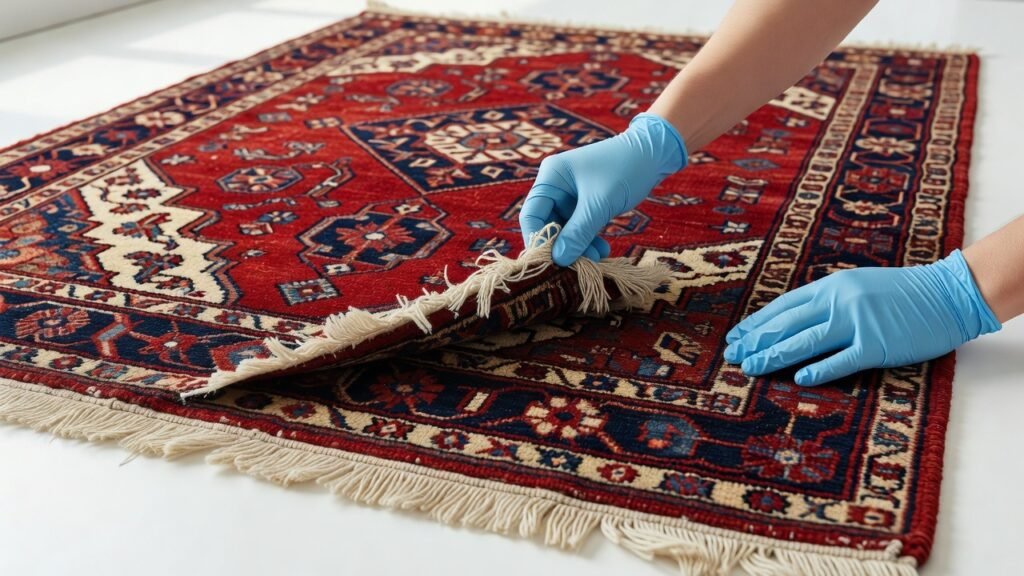
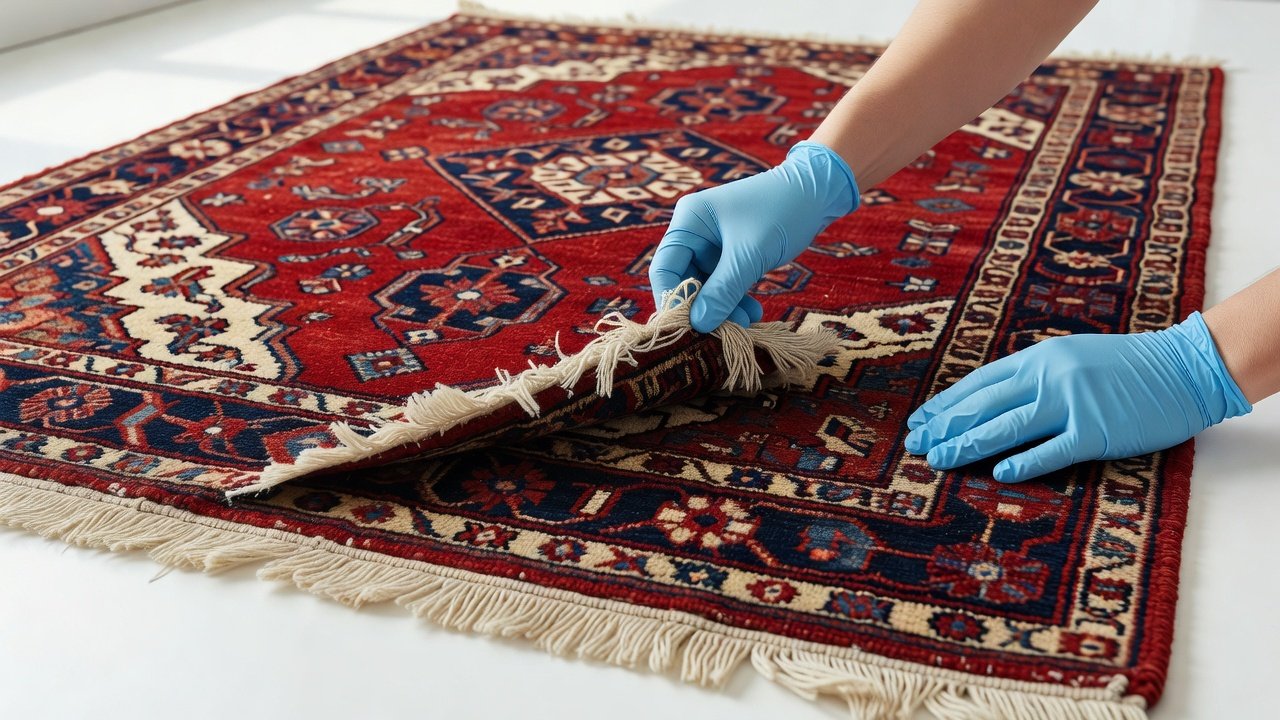
Before you touch anything, identify your rug’s approximate age and construction. Look at the back hand-knotted rugs show individual knots and slight irregularities in the pattern. Machine-made rugs have a perfectly uniform grid on the reverse. If you can’t tell, that uncertainty alone is a reason to have a professional assess it first. Misidentifying the construction type is one of the most common reasons DIY cleaning goes wrong.
Step 1 — Test Every Cleaning Product Before It Touches the Rug
This is non-negotiable. Take a white damp cloth and press it firmly against a small section of pile in an inconspicuous corner. If color transfers, the dye is unstable and the rug should not be wet cleaned at home under any circumstances. Do the same with any cleaning solution you plan to use apply a drop to an edge, wait two minutes, and blot. Bleeding dyes are irreversible, and in our facility, we’ve received antique rugs from clients in Tribeca and the Upper East Side where a single DIY spot treatment destroyed a medallion or border that took a weaver months to create.
Step 2 — Vacuum Correctly, and Only the Pile Side
Vacuuming is genuinely something you can and should do at home, but technique matters. Use a suction-only vacuum no beater bar, no rotating brush. Run it in the direction of the pile, not against it. Never vacuum the fringe; fringes on antique rugs are often original warps, not decorative additions, and a beater bar will shred them within a few passes.
For a rug in a high-foot-traffic area say, a dining room in a Murray Hill brownstone or a hallway in a prewar Riverside Drive building vacuum once a week on the face side. Flip the rug and vacuum the back every few months to dislodge the deep grit that surface passes miss. This is real maintenance that extends time between professional cleanings.
Step 3 — Handle Spills the Right Way, Not the Fast Way
Blot, don’t scrub. Use a clean white cloth and work from the outside of the spill toward the center. Cold water is almost always safer than warm. Avoid dish soap with degreasing agents they’re formulated to cut grease, which means they’re aggressive on natural lanolin in wool. A small amount of plain white vinegar diluted in water (about one part vinegar to four parts water) is a reasonable home option for light, water-based spills on wool.
What you should not attempt at home: pet urine, red wine that has dried, oil-based stains, or any spill that has reached the foundation. Urine, in particular, changes pH as it dries and can permanently alter vegetable dyes. The IICRC recommends professional treatment for any stain that has set or that involves biological material — and in our experience, that recommendation protects the rug and your money.
Step 4 — Never Machine Wash or Submerge an Antique Rug at Home
We hear this one regularly. A client in Chelsea once put a small antique Caucasian prayer rug through a front-load washer on the gentle cycle. The rug came out with the foundation warped, the pile matted in one direction, and the fringe tangled beyond repair. Antique rugs cleaned professionally are washed by hand in a controlled facility with proper pH-balanced solutions, fiber-specific rinse temperatures, and flat drying under tension. None of that is replicable in a bathtub or laundromat. Improper DIY rug cleaning including over-wetting and machine washing is one of the leading causes of irreversible damage to wool, silk, and hand-knotted rugs, according to the Rug and Textile Appreciation Society.
Step 5 — Know When to Call an Antique Rug Cleaning Service in Manhattan
Some situations aren’t judgment calls. If you notice any of the following, stop and contact a professional antique rug cleaning service Manhattan residents can reach quickly like our team at Upper Rug Cleaning:
- Visible foundation fibers (warp or weft) through the pile the rug is wearing thin
- Fringe that is rotting, discolored brown, or pulling away from the body of the rug
- A musty odor that doesn’t go away after airing this often means mold has reached the foundation
- Dye bleeding, you can see with the naked eye between colors
- Any stain that involves urine, blood, or mold
- A rug that hasn’t had a professional cleaning in more than 18 months
The IICRC recommends professional cleaning every 12 to 18 months for most households and for antique rugs in active Manhattan apartments, we’d lean toward the shorter end of that range, especially in buildings with radiant heat, which dries out wool fibers and makes them more brittle.
Step 6 — Store Antique Rugs Properly Between Cleanings
If you’re rotating rugs seasonally common in apartments from the Upper West Side to Kips Bay where space is at a premium storage done wrong is as damaging as poor cleaning. Roll the rug (never fold it) around an acid-free tube, pile side in, and wrap it in breathable cotton muslin. Avoid plastic sheeting, which traps humidity and creates exactly the conditions mold needs to establish itself. New York summers are humid enough that a rug stored in a closet in a plastic bag from June to September can arrive at our facility in the fall with significant mold damage.
Troubleshooting Tip: The Rug Looks Clean But Still Smells
This is the most common complaint we hear after a home cleaning attempt. If you’ve spot-treated a rug, let it dry, and the smell returns within a week, it almost always means moisture reached the foundation and didn’t dry completely or that a biological contaminant (urine, mold spores) was diluted and spread rather than removed. Surface drying is deceptive; the foundation of a thick antique rug can hold moisture for days in a humid Manhattan apartment. At that point, home remedies will keep masking the problem while the damage compounds. A professional wash, done flat with controlled drying, is the only real fix.
If you’re unsure where your rug stands, reach out to our team at upperrugcleaning.com. We pick up and deliver across Manhattan from Inwood to the Financial District and we’ll give you a straight assessment before any cleaning begins.
Frequently Asked Questions
How much does a professional antique rug cleaning service in Manhattan typically cost in 2026?
Pricing varies based on rug size, fiber type, and condition, but Manhattan clients generally see rates in the range of $4 to $8 per square foot for hand-knotted antique rugs requiring full wash and dry. A 9-by-12 antique Persian might run $430 to $865 depending on fiber complexity and stain treatment. Rugs with significant soiling, mold, or structural repair needs will be quoted separately. We provide written estimates before any work begins.
Can I have my antique rug picked up and delivered in Manhattan without a car?
Yes, and this is one of the most common questions we get from clients in buildings without doormen or in walk-up apartments in neighborhoods like Washington Heights or the East Village. We handle pickup and delivery across all of Manhattan. You don’t need a car, a doorman, or a specific window of time. We coordinate directly with you to make it as straightforward as possible.
How do I know if my old rug is actually antique and needs specialized care?
The clearest indicators are age documentation, country of origin (hand-knotted rugs from Iran, Turkey, the Caucasus, or Central Asia are most often antique or semi-antique), and construction visible individual knots on the reverse, slight pattern irregularities, and natural dye variation in the pile. If you’re unsure, we can assess the rug during pickup. We’d rather spend five minutes evaluating it than have you risk a cleaning method that isn’t right for the material.
Related from Upper Rug Cleaning: Rug Cleaning City · How Upper Rug Cleaning Earns and Verifies Customer Reviews in Manhatta · Professional Rug Cleaning Services in Manhattan, NY